


25 Nov Bias in Design: Designing for People Who Aren’t You
Part 12 of Build Wireframes and Low-Fidelity Prototypes — a series on the UX principles I use in client work.
Every designer brings assumptions to a project. That is not a character flaw. Instead, it is how brains work. We fill in gaps with what we already know, what we have seen before, and what feels normal to us. The trouble starts when those fill-ins go unexamined. Then a website quietly favors people like the designer. Everyone else has to work around it. Bias in design is not usually malice. It is usually an unexamined assumption, built into a screen, that nobody noticed until a visitor tripped over it.
The most discussed form is implicit bias: the attitudes and associations we hold without consciously knowing it. They can be positive or negative. In fact, they feel like common sense, which is exactly why they are dangerous. A designer who assumes every visitor reads comfortably on a phone will not notice the problem. Take a donation form with tiny, low-contrast text. It excludes a visitor with low vision. Or take a designer who assumes every visitor arrives by car. They will not notice the gap. The festival site’s directions mention parking. They never mention the bus stop two blocks away. Then there is the designer who assumes every household looks like their own. They will write greeting copy. It welcomes one kind of family. It silently un-welcomes every other kind. Nobody made those decisions to exclude anyone. All of them exclude someone.
A few biases worth knowing by name
Implicit bias is the umbrella. Several specific habits show up again and again in design work. Naming them makes them easier to catch.
Confirmation bias is reading research in a way that supports what you already believed. You show five people a homepage. Four struggle with the navigation. One loves it. You remember the one, because the one agreed with you. However, the fix is boring and effective. Write down what you expected before you test. Count what actually happened, including the results you did not want.
False-consensus bias is assuming your own opinions and habits are common. You would never tap that button, so you assume nobody would. Or you would tap it instantly, so you assume everyone will. Your habits are data about one person. They are not data about your visitors.
Sunk-cost bias is sticking with a design because you already spent time on it. A homepage layout that took a week to build feels harder to abandon than a sketch that took ten minutes. Testing may still say the sketch worked better. Paper wireframes help here, precisely because they are cheap to abandon. The more expensive a design feels, the more honestly you have to ask one question. Are you defending it, or defending the time you spent on it?
There are many more. You may remember the first and last things in a list better than the middle. Patterns may appear in random feedback. Answers may come out in ways that make you look good. You do not need to memorize the catalogue. Therefore, you need the habit underneath all of them. Treat every design idea as a hypothesis, not a verdict. Be willing to change direction when the research disagrees with you.
How bias gets into a website, and how research keeps it out
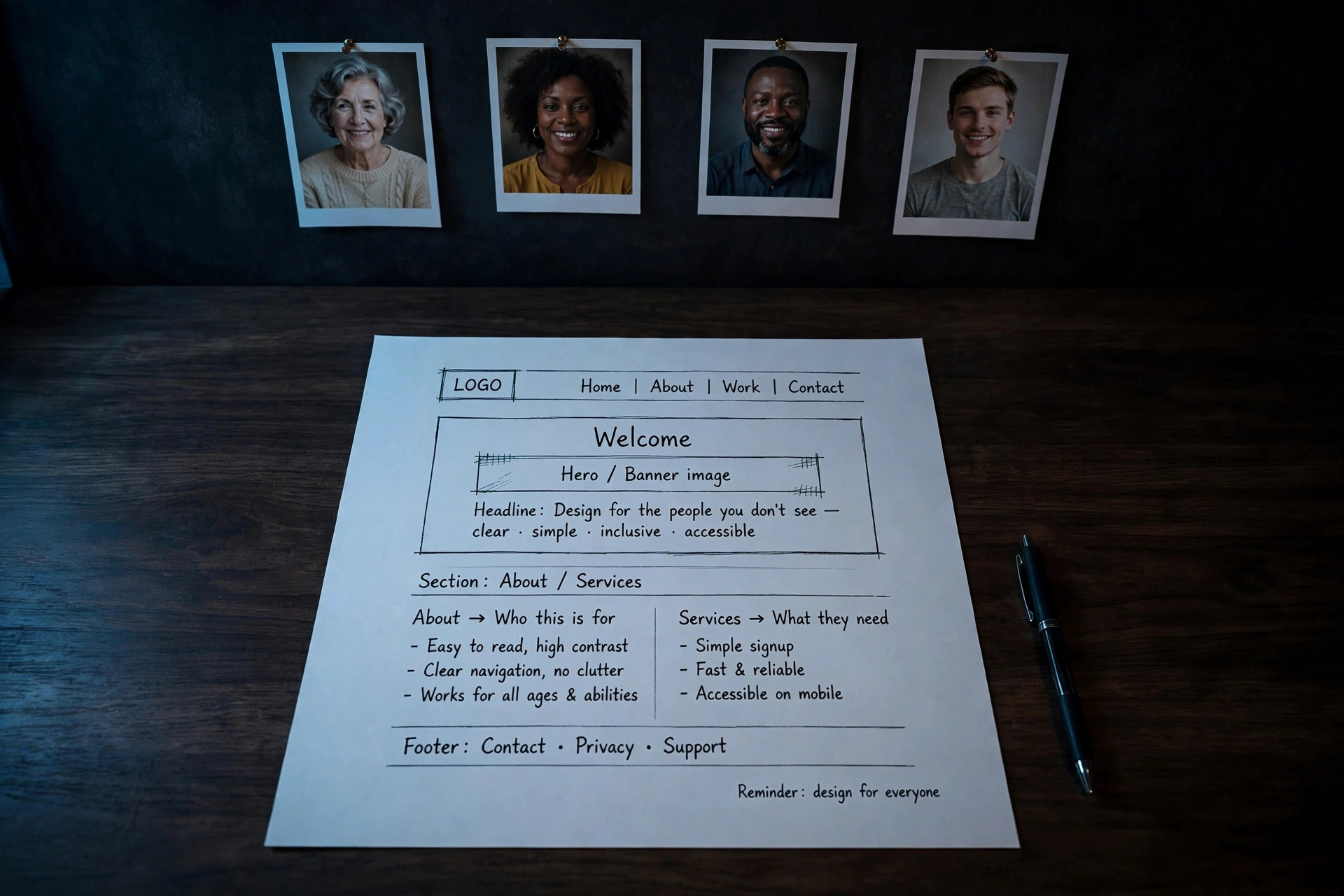
Bias enters design at the same places good design enters: personas, journeys, and testing. If you draw personas only from people like the designer, they will describe only people like the designer. A journey map that only follows the visitor who already knows the organization will miss the first-time guest. If testing only involves friends, colleagues, or the easiest people to recruit, it will confirm the design for exactly those people. It will confirm it for nobody else.
The counterweights are practical, not heroic. Make personas inclusive on purpose. Include visitors of different ages, abilities, languages, incomes, and familiarity with the organization. Check those personas against real research, not against your assumptions. For instance, test with a diverse group, including people who do not resemble you or your team. Listen hardest to the visitors whose experience differs most from your own. They are the ones most likely to find the assumptions you missed. Work with a diverse team wherever you can. A colleague who spots an assumption you cannot see is worth more than any checklist.
Two more counterweights
Two more habits help. First, a pre-mortem. Before building, sit down and imagine the project has already failed. Then brainstorm everything that could have gone wrong. That exercise, done honestly, surfaces oversights while they are still cheap to fix. Think of a form that assumes a title nobody uses. Or a schedule that assumes everyone drives. Or a signup that assumes everyone has an email address they check daily. Second, prioritize impact over output. Judge a design by what it does for visitors, not by how much of it got shipped. A smaller site that serves everyone beats a larger site that quietly serves only some people.
None of this removes bias entirely. No designer gets to claim that. What it does is make bias visible, checkable, and correctable. That is the difference between a website that accidentally excludes people and a website that keeps learning how to include them. Finally, good design is not design by people who have no assumptions. It is design by people who know they have assumptions and built a process to catch them.
The next post is about the other side of that responsibility. It covers when design does not just overlook people, but actively tricks them.
Want your site’s structure sketched before it’s built? Shaun M. Johnson, owner of Signature Web Design is a full service Web designer, SEO, UI/UX, Graphic Design, and Logo and Branding Expert serving Goldsboro, Greenville, Kinston, Raleigh, Wilmington, Wilson and surrounding areas in North Carolina — with websites designed across the country. Get a free consultation or see recent work.
Previous in this series: Digital Low-Fidelity Prototypes · Next: Deceptive Patterns and Honest Design