

29 Nov A Research Plan in Plain English: The Seven Elements
Part 2 of Conduct UX Research and Test Early Concepts — a series on the UX principles I use in client work.
Every good test I have ever run started the same way: with a plan written down before anybody touched a prototype. Not a fifty-page document. A short plan, clear enough that anyone on the team could read it and say, “Yes, that is what we are testing, and this is how we will know whether it worked.”
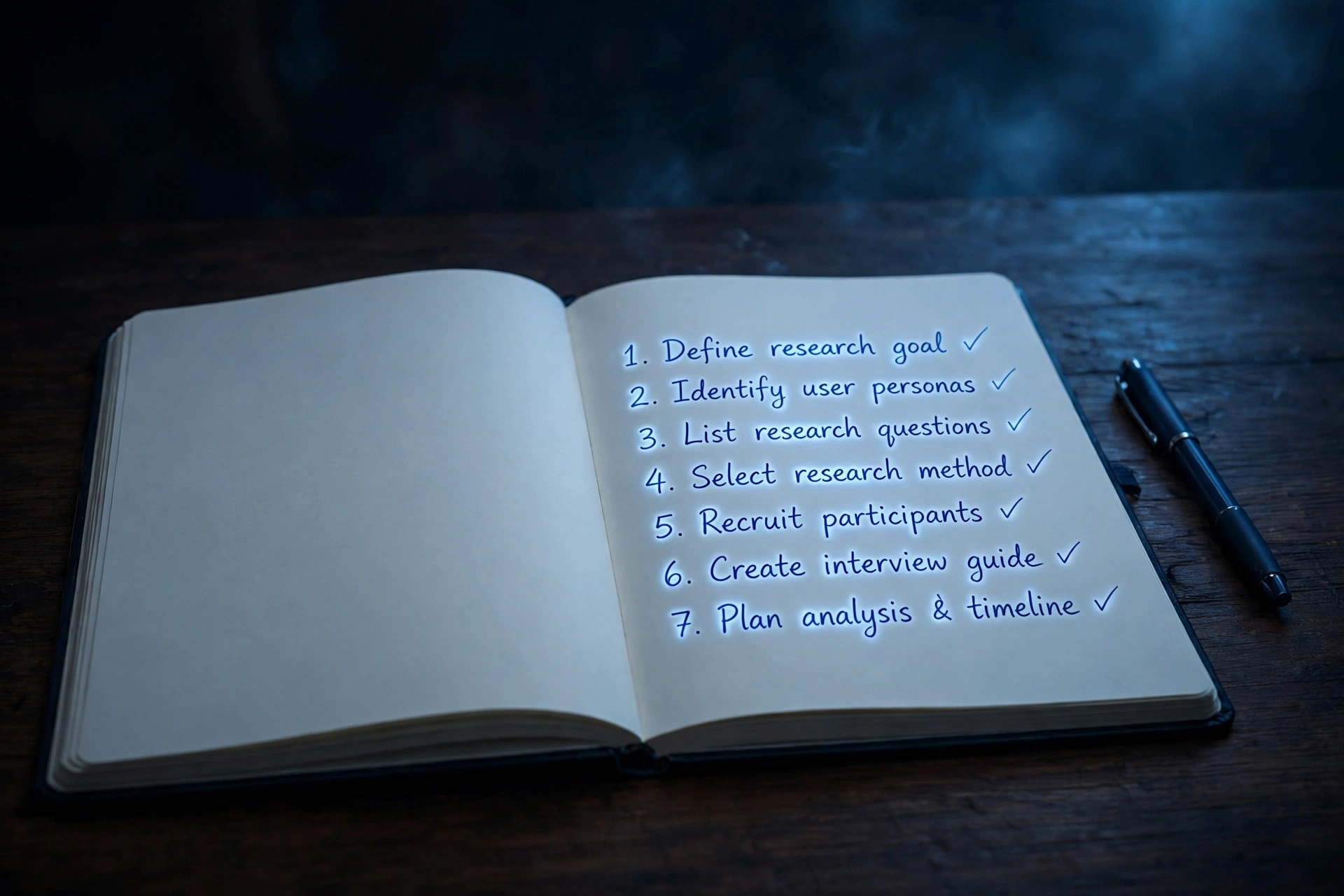
Without that plan, testing drifts. You watch a few people, you form impressions, you fix whatever annoyed you most — and you cannot say whether the fix helped, because you never said what “helped” meant. A research plan stops that drift. It has seven elements, and none of them is complicated once you strip away the jargon.
1. Project background: why are we doing this?
The background is a few lines on what led you here. What problem are you trying to solve, what has already been tried, and what decision will this research inform? It gets the whole team on the same page before the study starts, and it gives you credibility later, when you present findings to people who were not in the room. If you cannot explain why you are testing in three sentences, you are not ready to test yet.
For a festival site, the background might be: “Visitors keep asking where today’s schedule is, even though it is on the site. We redesigned the schedule path. We need to know whether visitors can now find it on a phone, before we launch.” That is enough. Concise beats comprehensive here, because a plan nobody reads helps nobody.
2. Research goals: what do you want to learn?
Goals state what you want to learn, or what outcome you want from the research. They drive the entire study — every later element should trace back to them. Goals also change depending on when you test. Before design, goals ask whether you should build something at all. During design, they ask how to build it. After launch, they ask whether it worked.
A test-phase goal for a nonprofit site might be: “Find out whether donors can complete a gift without stalling, and where they stall if they do.” That goal is specific, it names a real job, and it tells you exactly what to watch for. “Improve the website” is not a goal. It is a wish.
3. Research questions: what, exactly, are you answering?
Research questions are the handful of questions your study is trying to answer. They are not the questions you ask participants — those come later, in the script. Research questions are the questions you, the designer, need answered. They should be actionable (you can tell when you have found the answer), specific (not so broad that any answer fits), and neutral (not phrased to assume the answer you want).
“How long does it take a visitor to find today’s schedule?” is a good research question: it is measurable, specific, and neutral. “What frustrated visitors most about finding the schedule?” is also good: it is qualitative, but still specific. Notice how the first gives you numbers and the second gives you reasons. You usually need both, and the mix you choose decides whether your study leans quantitative or qualitative. Neither is better on its own. Numbers tell you how often something happens. Words tell you why.
4. Key performance indicators: how will you measure it?
Key performance indicators, or KPIs, are the measures you will use to judge progress toward your goal. You do not need all of them — you pick the two or three that map most closely to your goals, and the next post in this series goes through them properly. For now, just know that KPIs belong in the plan before the study, not invented afterwards to make the results look good. Deciding what counts as success after you have seen the results is not measurement. It is storytelling.
5. Methodology: what will you actually do?
Methodology is the steps you will take: what method you will use, when and where the study happens, who runs it, and how you will collect and analyze the data. For most of this series, the method is a usability study — watching people try real tasks in a prototype — and later posts will cover moderated and unmoderated versions of it. The methodology section also tells stakeholders what to expect, which makes them more likely to act on the findings, and it makes the study repeatable: another person, following the same steps, should get similar results. If they could not, your findings are an anecdote, not evidence.
6. Participants: who will you watch?
Participants are the people you will study, and they should represent your real users. Your plan should list the characteristics that matter — and a reason for each one — based on your goals. It should also include a screener: a short set of questions that checks whether a potential participant actually fits. And it should say how you will thank them, whether with payment, a gift card, or another incentive. A later post covers recruiting fairly, including people with diverse backgrounds and abilities, because a study that only watches one kind of visitor only tells you about one kind of visitor.
7. Script: what will you say and ask?
The script, sometimes called a discussion guide, is the set of questions and instructions you will use with every participant, in the same order, so every session is comparable. It includes the welcome, the consent to record, the tasks themselves, and the closing questions. Using the same script is not about being robotic. It is about being fair: if you ask different people different questions, you cannot compare their answers, and you cannot tell whether a difference came from the design or from you.
Why the plan matters more than the test
Here is the uncomfortable truth about testing: the plan is more important than the session itself. A mediocre prototype, tested under a clear plan, still teaches you something. A polished prototype, tested without one, teaches you mostly about your own impressions. The plan forces you to decide, before you have results to defend, what you are looking for, who counts as evidence, and what would change your mind.
That is why this series spends so much time on planning before it ever gets to a live session. The next few posts walk through the elements that trip people up most: choosing measures that mean something, recruiting fairly, writing a script that gets honest answers, and handling privacy with care. Each one is short. Together, they are the difference between “we tested it” and “we know.”
Want a test plan for your next redesign? Shaun M. Johnson, owner of Signature Web Design is a full service Web designer, SEO, UI/UX, Graphic Design, and Logo and Branding Expert serving Goldsboro, Greenville, Kinston, Raleigh, Wilmington, Wilson and surrounding areas in North Carolina — with websites designed across the country. Get a free consultation or see recent work.
Previous in this series: Testing Is Part of Design · Next: Goals, Questions, and Numbers That Actually Mean Something